URL Slug: /low-budget-marketing-strategies-for-startups
Meta Description (160 chars):
Low budget marketing strategies for startups that drive growth fast. Discover free marketing tools, startup marketing plan & proven tactics.
Introduction: How I Built Growth Without Burning Cash
When I first started working with startups, the biggest challenge wasn’t creativity—it was budget.
Every founder asked me the same question:
“How do we grow without spending too much?”
That’s where low budget marketing strategies became my core expertise. Over time, I realized something powerful:
👉 Startups don’t lose because of low budgets.
👉 They lose because of wrong strategy and lack of clarity.
In this guide, I’ll walk you through a real-world startup marketing plan, combining free marketing tools, SEO, content, and smart distribution tactics—all designed to generate maximum ROI with minimal investment.
Low Budget Marketing Strategies That Actually Work in 2026
Let me be very honest—cheap marketing doesn’t mean ineffective marketing.
The right low budget marketing strategies focus on:
- Organic visibility
- Smart targeting
- Compounding growth
Let’s break it down step by step.
1. Build a Strong Startup Marketing Plan First
Before using any free marketing tools, I always start with clarity.
What I include in every startup marketing plan:
- Target audience (pain points, behavior)
- Primary traffic channel (SEO, social, ads)
- Content strategy (topics + intent)
- Conversion path (landing page, CTA)
💡 Mistake I see often:
Startups jump into Instagram or ads without defining positioning.
Mini Framework I Follow:
- Awareness → Content (blogs, reels)
- Consideration → Case studies, guides
- Conversion → Landing pages, offers
2. SEO: The Highest ROI Low Budget Strategy
If you ask me one strategy that consistently works, it’s SEO.
Why? Because it compounds.
How I use SEO in low budget marketing strategies:
- Focus on long-tail keywords
- Build topical authority clusters
- Optimize for AI Overview (AEO)
Example:
Instead of targeting:
❌ “marketing”
✅ “low budget marketing strategies for startups”
Key SEO Actions:
- Use keywords in headings (H1–H3)
- Add internal linking
- Optimize meta tags
- Write intent-based content
3. Content Marketing: My #1 Growth Engine
Content is where startups win big.
When I build a startup marketing plan, content becomes the foundation.
Types of content I recommend:
- Blog articles (SEO)
- LinkedIn posts (authority)
- Short-form videos (reach)
- Case studies (trust)
Storytelling Tip:
People don’t buy products. They buy solutions and stories.
🧠 Client Story #1: SaaS Startup Growth
One of my clients had:
- Zero ad budget
- No brand presence
We focused only on:
- SEO blogs
- LinkedIn content
Within 4 months:
- Organic traffic grew by 220%
- Leads increased without ads
👉 That’s the power of low budget marketing strategies done right.
4. Use Free Marketing Tools Smartly
You don’t need expensive tools to start.
Here are my go-to free marketing tools:
SEO Tools:
- Google Search Console
- Google Keyword Planner
- Ubersuggest (free version)
Content Tools:
- Canva (design)
- ChatGPT (content ideation)
- Grammarly (editing)
Analytics Tools:
- Google Analytics
- Hotjar (basic heatmaps)
💡 Pro Tip:
Don’t use too many tools—master a few.
5. Social Media: Focus on One Platform First
One of the biggest mistakes startups make is trying to be everywhere.
I always suggest:
👉 Pick ONE platform and dominate it.
Platform Strategy:
- LinkedIn → B2B startups
- Instagram → D2C brands
- YouTube → Education/content-heavy niches
My Approach:
- 3–4 posts per week
- Mix of value + storytelling
- Clear CTA
6. Build an Email List Early
Email marketing is underrated in low budget marketing strategies.
Why? Because you OWN the audience.
How I do it:
- Offer free lead magnets (ebooks, checklists)
- Use simple email tools (Mailchimp free plan)
- Send weekly value emails
Example Lead Magnet:
“Startup Marketing Plan Template (Free Download)”
7. Collaborations & Partnerships
Growth doesn’t always come from ads.
Sometimes, it comes from audience sharing.
What I recommend:
- Partner with micro-influencers
- Guest blogging
- LinkedIn collaborations
🧠 Client Story #2: E-commerce Brand
We collaborated with:
- 5 micro-influencers (no payment, only product exchange)
Results:
- 40% increase in traffic
- 25% increase in sales
👉 Zero ad spend.
8. Optimize for Conversions (Not Just Traffic)
Traffic without conversion is useless.
In every startup marketing plan, I focus on:
Conversion Elements:
- Strong headline
- Clear CTA
- Social proof
- Simple design
Example CTA:
“Start Your Free Trial Today”
9. Repurpose Content Like a Pro
This is one of my favorite low budget marketing strategies.
One blog = Multiple content pieces:
- Blog → LinkedIn post
- Blog → Instagram carousel
- Blog → YouTube short
💡 This multiplies reach without extra cost.
10. Track, Analyze, Improve
Marketing without data is guessing.
Metrics I track:
- Traffic sources
- Conversion rate
- Engagement
Tools:
- Google Analytics
- Search Console
Image Alt Tag Example
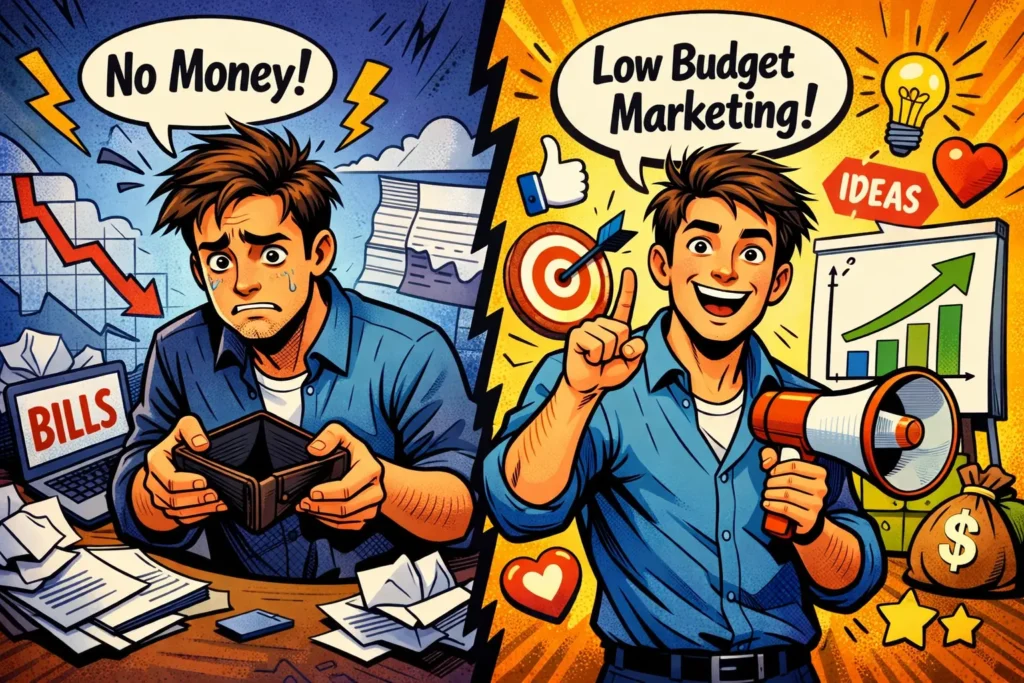
Alt Text: “low budget marketing strategies for startups infographic comic style”
FAQs: Budget-Friendly Marketing Strategies for Startups
1. What are the best low budget marketing strategies for startups?
The best strategies include SEO, content marketing, social media focus, and using free marketing tools to maximize ROI.
2. Can startups grow without paid ads?
Yes. With a strong startup marketing plan, startups can grow using organic channels like SEO and content marketing.
3. Which free marketing tools should I use first?
Start with Google Analytics, Search Console, Canva, and keyword research tools.
4. How long does SEO take for startups?
Typically, 3–6 months to see consistent results, depending on competition and content quality.
5. Is content marketing enough for growth?
Yes, if combined with SEO, distribution, and conversion optimization.
Final Thoughts: What I Want You to Remember
If you take one thing from this article, let it be this:
👉 You don’t need a big budget.
👉 You need a smart system.
The best low budget marketing strategies are:
- Consistent
- Data-driven
- Customer-focused
Start small. Stay consistent. Scale smart.